Get a free quote:

Pool Care & Renovation Insights

Salt water pool paint

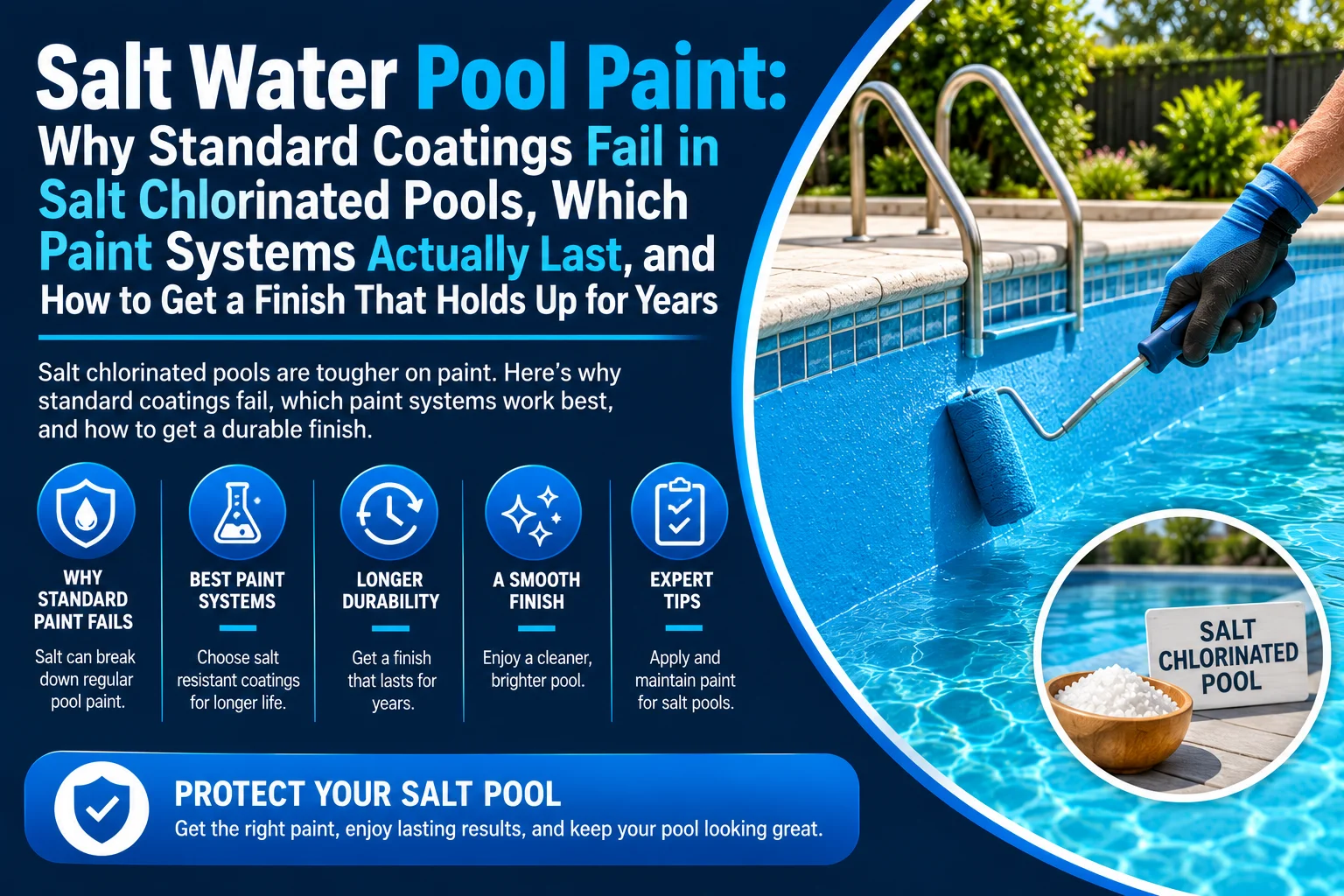
Salt Water Pool Paint: Why Standard Coatings Fail in Salt Chlorinated Pools, Which Paint Systems Actually Last, and How to Get a Finish That Holds Up for Years

Quick Overview:

Salt water pools use a chlorinator to convert dissolved salt into chlorine, and that process creates a chemical environment that is harder on pool paint than a traditionally chlorinated pool. The chlorine generated by a salt cell is produced continuously at the water surface and around the return jets, which means the coating is exposed to consistent chemical contact rather than the fluctuating levels you get from manual dosing. Salt itself is also mildly corrosive to certain coating types, and the higher pH that salt systems tend to run at accelerates paint breakdown if the water chemistry is not managed carefully. The result is that paint systems which last well in a standard chlorine pool often fail earlier in a salt water pool, showing chalking, blistering, or adhesion loss within a few years. The two paint types that perform best in salt water pools are two-pack epoxy and chlorinated rubber, but each has trade-offs. Epoxy is the most chemically resistant and longest lasting option (seven to ten years in a well-maintained salt pool), but it requires professional application and thorough surface preparation. Chlorinated rubber is easier to apply and recoat, but has a shorter lifespan (three to five years) and is more vulnerable to the sustained chemical load of a salt system. At Advance Pool Painting, we assess your pool surface, salt chlorinator output, and water chemistry before recommending a coating system. As Dulux and Luxapool accredited pool painters, we use commercial-grade products formulated for salt water environments and back every job with a warranty.

Why Salt Water Pools Are Harder on Paint

Salt water pools do not use salt as a sanitiser directly. The salt (sodium chloride) is dissolved in the water and passed through an electrolytic cell, which splits it into chlorine and sodium hydroxide. The chlorine sanitises the pool. The sodium hydroxide raises the pH.

This process creates three conditions that are tougher on pool paint than a traditionally chlorinated pool.

Continuous chlorine production. In a manually dosed pool, chlorine levels rise after dosing and fall between treatments. In a salt pool, the chlorinator produces chlorine continuously while running, which means the coating is under constant chemical contact during operating hours. This sustained exposure accelerates the breakdown of less chemically resistant coatings.

Higher pH tendency. The sodium hydroxide produced as a byproduct of salt chlorination pushes the pH upward. If not corrected regularly with acid, the water runs alkaline. Alkaline water softens and degrades many paint films, particularly chlorinated rubber coatings. It also causes calcium scaling on the pool surface, which bonds to the paint and damages it when removed.

Salt corrosion. While the salt concentration in a pool (typically 3,000 to 6,000 ppm) is much lower than seawater, it is still enough to corrode certain materials over time. Coatings that are not formulated for salt exposure can lose adhesion as salt penetrates micro-cracks in the paint film and works between the coating and the substrate.

These factors combined mean that a paint job which lasts six to eight years in a standard chlorine pool might only last three to five years in a salt water pool if the wrong coating is used or the surface preparation is not thorough enough.

Which Paint Types Work Best in Salt Water Pools

Not all pool paints are equal, and the difference matters more in a salt water pool than in any other pool type.

Two-pack epoxy is the strongest option for salt water pools. It cures through a chemical reaction between a resin and a hardener, creating a dense, cross-linked film that resists chemical penetration, salt corrosion, and UV degradation. In a well-maintained salt pool with balanced water chemistry, a quality epoxy system lasts seven to ten years before recoating is needed. Epoxy also resists blistering, which is one of the most common failure modes in salt water pools. The trade-off is that epoxy requires meticulous surface preparation (the substrate must be completely clean, dry, and profiled), professional application, and adequate curing time before the pool is refilled. It is not a DIY-friendly product.

Chlorinated rubber is the second option. It dries quickly, is easier to apply, and can be recoated without removing the existing layer (provided the existing coat is in reasonable condition and is also chlorinated rubber). In a salt water pool, chlorinated rubber typically lasts three to five years. It is more vulnerable to the constant chlorine exposure and pH fluctuations of a salt system than epoxy, but it is a practical choice for pool owners who prefer a lower upfront cost and are comfortable with more frequent recoating cycles. Chlorinated rubber works best in salt pools where the water chemistry is well maintained and the chlorinator output is not set excessively high.

Acrylic and water-based paints are not recommended for salt water pools. These coatings do not have the chemical resistance to withstand continuous chlorine production and salt exposure. They tend to chalk, fade, and lose adhesion within one to two years in a salt environment. If your pool currently has an acrylic coating and you are running a salt chlorinator, the best long-term move is to strip the existing paint and switch to an epoxy system at the next repaint.

Common Salt Water Pool Paint Failures and Why They Happen

Understanding why paint fails in salt water pools helps you avoid the same outcomes.

Blistering and bubbling. This is the most common failure in salt pools. It happens when moisture or chemicals penetrate the paint film and become trapped between the coating and the pool shell. The continuous chlorine exposure in salt pools accelerates this penetration. Blistering is almost always a preparation issue: the substrate was not dry enough when painted, the surface was not properly primed, or the existing coating was not fully removed before repainting. Our guide on pool paint blistering covers the full diagnosis and repair process.

Chalking and fading. The paint surface becomes powdery and the colour washes out. This is caused by UV exposure combined with chemical degradation. Salt pools accelerate chalking because the constant chlorine load breaks down the paint binder faster than intermittent dosing would. Epoxy coatings resist chalking significantly better than chlorinated rubber. If you are choosing a pool paint colour for a salt water pool, be aware that lighter shades show chalking less than darker ones.

Adhesion loss and peeling. The paint lifts away from the pool shell in sheets or flakes. In salt pools, this usually happens because salt has worked its way between the coating and the substrate through micro-cracks or pinholes in the paint film. Once salt is behind the coating, it draws moisture through osmosis, which breaks the bond. This is why surface preparation is critical: every crack, void, and defect in the existing surface must be repaired before the new coating goes on. If your surface is showing early signs of failure, an inspection can determine whether a repair or full repaint is needed.

Staining and discolouration. Salt chlorinators can cause localised staining around the return jets where freshly generated chlorine enters the pool at higher concentrations. Metal components in the salt cell can also release trace amounts of copper or iron into the water, which deposit on the paint surface as coloured stains. This is not a paint failure as such, but it affects the appearance. Keeping the salt cell clean, maintaining balanced water chemistry, and using a metal sequestrant prevents most staining.

Surface Preparation for Salt Water Pool Painting

The preparation stage is where the longevity of a salt water pool paint job is decided. No coating, however chemically resistant, will perform if the substrate is not properly prepared.

The standard preparation process for a salt water pool repaint includes:

Draining and cleaning. The pool is fully drained and cleaned to remove all water, debris, algae, and chemical residue. Salt residue is particularly important to remove because any salt left on the surface will prevent paint adhesion.

Existing coating assessment. The current paint is assessed for adhesion, thickness, and condition. If it is peeling, blistering, or heavily chalked, it needs to be fully removed. If it is sound and well-adhered, it may be suitable for overcoating (chlorinated rubber over chlorinated rubber only, never epoxy over chlorinated rubber).

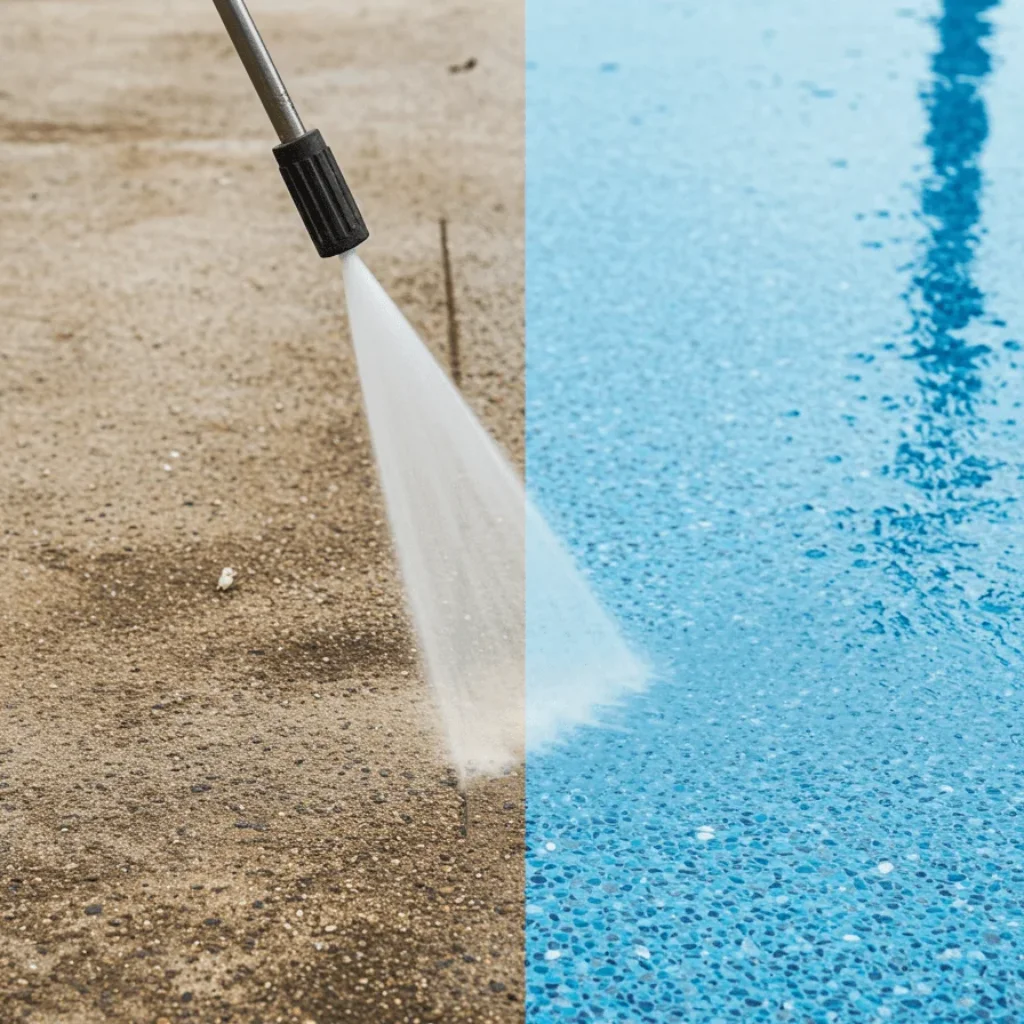
Mechanical preparation. The surface is prepared using high-pressure water blasting, abrasive blasting, or diamond grinding to create a profile that the new coating can grip. This step is essential for epoxy coatings, which require a clean, profiled substrate with no contamination.

Crack and defect repair. All cracks, voids, and damaged areas are repaired before coating. In a salt water pool, even hairline cracks can allow salt and moisture behind the coating, so the repair standard is higher than for a standard chlorine pool.

Drying. The surface must be completely dry before coating. Moisture trapped under epoxy is the leading cause of blistering. Professional painters use moisture meters to confirm the substrate is below the acceptable moisture threshold before the first coat goes on.

Priming. A compatible primer is applied to seal the substrate and provide a bonding layer for the topcoat. The primer must be compatible with both the substrate material and the topcoat system.

What to Ask Your Pool Painter Before Recoating a Salt Water Pool

Not every pool painter has experience with salt water systems. These questions help you assess whether they understand the specific requirements.

What coating system do you recommend for a salt water pool, and why? The answer should reference the chemical demands of salt chlorination and explain why the recommended product is suitable. If they suggest a generic pool paint without mentioning salt compatibility, that is a concern.

How will you prepare the surface? The answer should include stripping or profiling the existing coating, repairing defects, and moisture testing. If the preparation sounds minimal (a quick wash and straight to painting), the job is likely to fail early.

What is the expected lifespan of the coating in a salt water pool specifically? Lifespan claims should be realistic: seven to ten years for epoxy, three to five for chlorinated rubber. If they quote the same lifespan as a standard chlorine pool without qualification, they may not be accounting for the additional chemical load.

Do you carry accreditation with the paint manufacturer? Accreditation means the painter has been trained in the product system and the manufacturer stands behind the work. At Advance Pool Painting, our Dulux and Luxapool accreditation means we use products specifically formulated for Australian pool conditions, including salt water environments.

What warranty do you offer? A warranty should cover both material and workmanship. Ask whether salt water exposure affects the warranty terms, and get the details in writing before work starts.

Maintaining Your Paint After Recoating

A quality paint job on a salt water pool needs ongoing maintenance to reach its full lifespan.

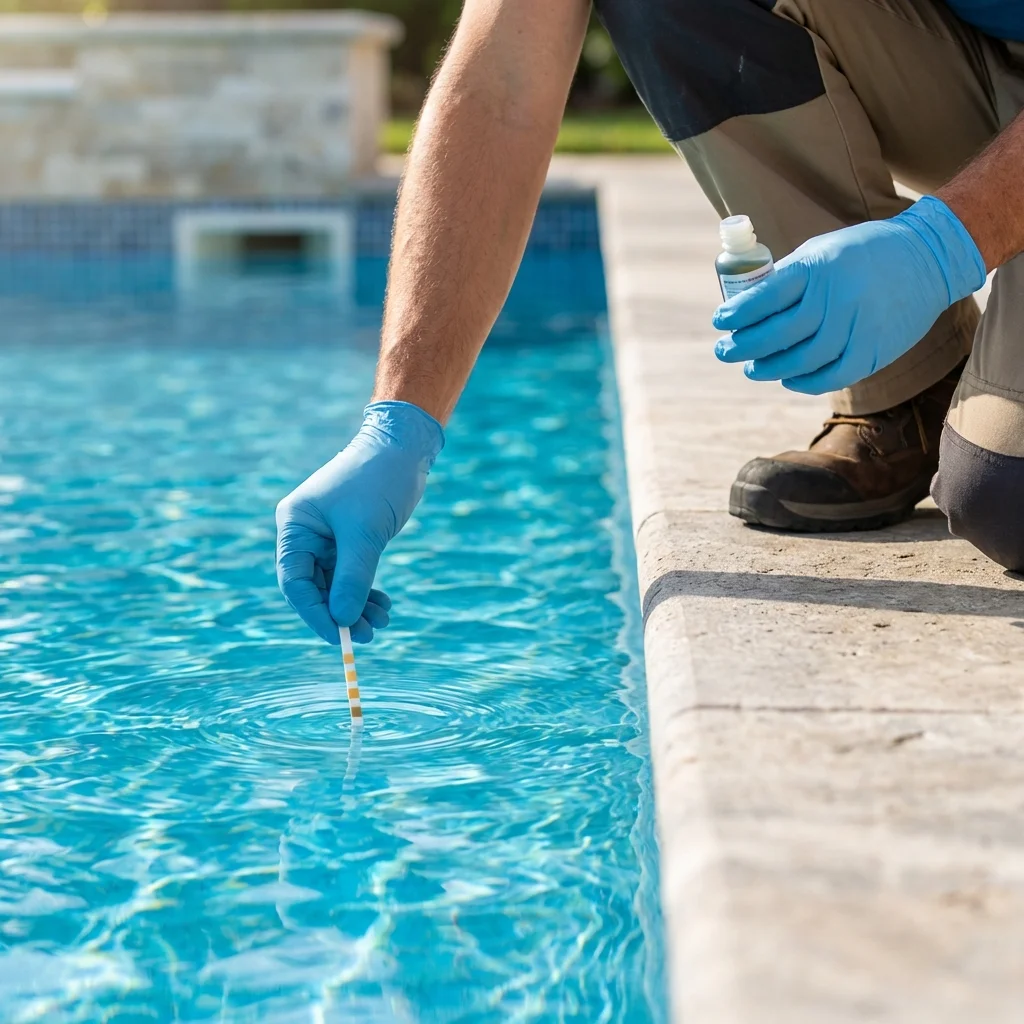
Balance your water chemistry weekly. Salt pools need more frequent pH adjustment than traditionally chlorinated pools because the chlorinator naturally drives pH upward. Keep pH between 7.2 and 7.6, total alkalinity between 80 and 120 ppm, and salt level within the manufacturer’s recommended range for your chlorinator (typically 3,000 to 5,000 ppm). Check your chlorinator output and ensure it is not running higher than necessary, as excess chlorine production accelerates paint wear.

Clean the salt cell regularly. A scaled or dirty salt cell works harder, produces chlorine unevenly, and can release metals into the water that stain the paint surface. Inspect and clean the cell every three to six months, or as recommended by the manufacturer.

Address stains early. If you notice discolouration around return jets or on the pool floor, treat it promptly. Stains that are left too long can penetrate the paint film and become permanent. A metal sequestrant added to the water helps prevent metal-based staining.

Watch for early signs of failure. Chalking, small blisters, or areas where the colour looks patchy are early warning signs. Catching these early means a resurfacing at the right time rather than an emergency repaint after the coating has failed across the entire pool.

Book an annual pool inspection. A professional pool inspection checks the paint condition, identifies early failure, and assesses whether maintenance or recoating is needed. This is especially valuable for salt water pools where paint degradation can be less visible until it reaches an advanced stage.

Ready to repaint your salt water pool? Contact Advance Pool Painting for a free inspection and quote. We service all Sydney regions and specialise in coatings that are built to handle salt chlorination.
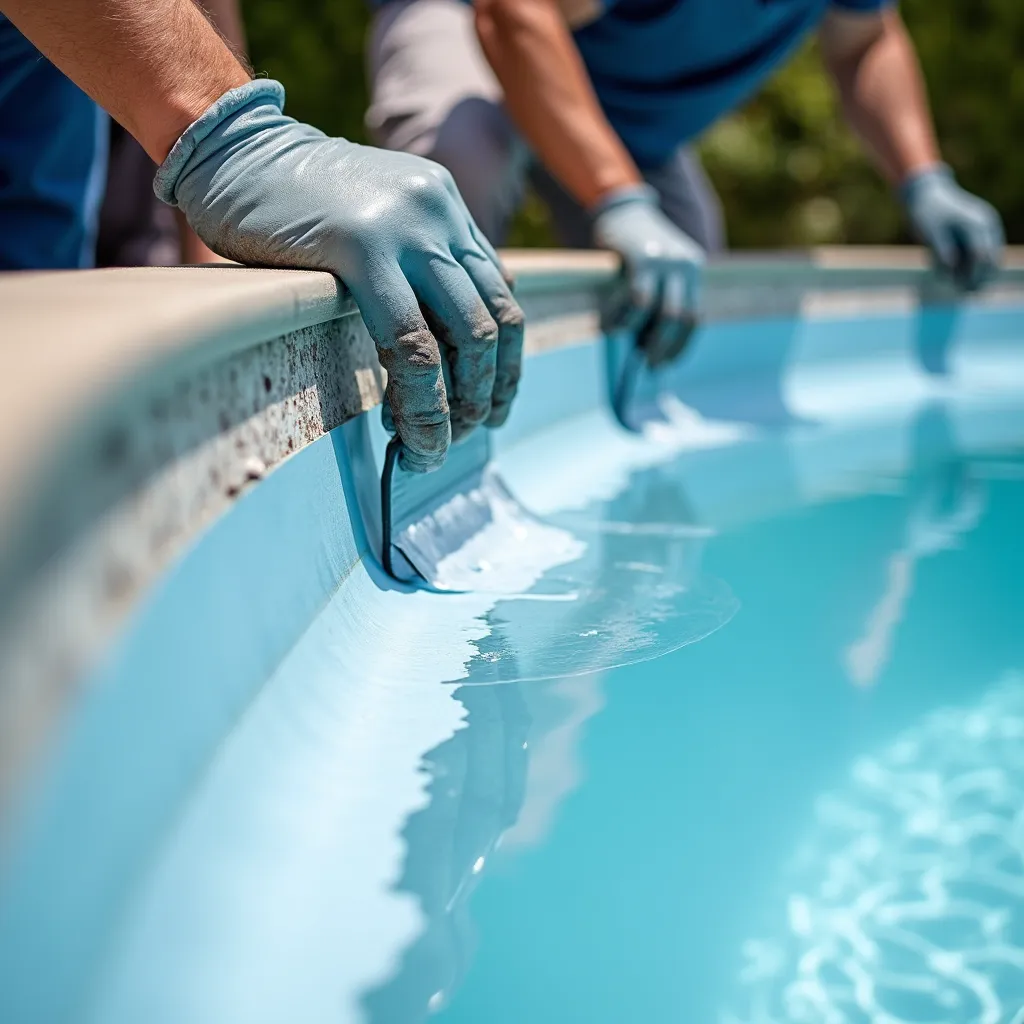
Salt Water Pool Paint

Why salt chlorination is tougher on coatings, which paint systems work, and how to get a finish that lasts.

Why Salt Water Pools Are Harder on Paint

⚡

Continuous Chlorine

Salt chlorinators produce chlorine constantly while running. The coating is under sustained chemical contact, not intermittent dosing.

📈

Higher pH Tendency

Salt chlorination produces sodium hydroxide as a byproduct, pushing pH upward. Alkaline water softens and degrades paint films.

🧂

Salt Corrosion

Pool salt levels (3,000 to 6,000 ppm) are enough to corrode coatings not formulated for salt exposure over time.

Epoxy vs Chlorinated Rubber for Salt Water Pools

RECOMMENDED

Two-Pack Epoxy

✅ Lifespan: 7 to 10 years in salt water

✅ Best chemical resistance

✅ Resists blistering and chalking

✅ Dense cross-linked film blocks salt

⚠️ Higher upfront cost

⚠️ Requires professional application

ALTERNATIVE

Chlorinated Rubber

✅ Lifespan: 3 to 5 years in salt water

✅ Lower upfront cost

✅ Faster drying and easier to apply

✅ Can recoat without full strip

⚠️ Less resistant to constant chlorine

⚠️ More vulnerable to pH fluctuations

Common Failures in Salt Water Pools

💧

Blistering

Moisture or salt trapped under the film. Usually a preparation issue.

🌫️

Chalking

Powdery surface and colour washout from UV and constant chlorine exposure.

📄

Peeling

Salt works behind the coating through micro-cracks, breaking the bond.

🟤

Staining

Metal deposits from salt cell or localised chlorine near return jets.

Preparation Steps for Salt Water Pool Painting

1

Drain and Clean

Remove all water, debris, algae, and salt residue from the pool shell.

2

Assess Existing Coating

Test adhesion, check for blistering, and determine if stripping is needed.

3

Blast or Grind Surface

Profile the substrate with high-pressure blasting or diamond grinding for grip.

4

Repair All Defects

Fill every crack and void. Even hairline cracks let salt behind the coating.

5

Moisture Test and Dry

Confirm substrate is below the moisture threshold. This is the leading cause of blistering.

6

Prime and Coat

Apply compatible primer, then two to three coats of the selected paint system.

💡 Key Takeaway

Salt water pools need a coating that can handle continuous chlorine production, elevated pH, and salt corrosion. Two-pack epoxy is the strongest option, lasting seven to ten years. Chlorinated rubber works for a lower upfront cost but needs recoating sooner. Surface preparation is the single biggest factor in how long any coating lasts in a salt water pool.

advancepoolpainting.com | Advance Pool Painting | Serving All Sydney

Get Started Today

Request your free, detailed quote now. We’ll inspect your pool, discuss tile options, explain the complete process, and provide transparent pricing with no hidden costs.

Call us or contact our team to schedule your consultation. We serve all Sydney areas including Western Sydney, The Hills, Northern Sydney, Eastern Sydney, and Southern Sydney.

Visit our gallery to see completed retiling projects and the transformations we’ve delivered for Sydney homeowners.

Additional Pool Renovation Resources

Explore more ways to enhance your swimming pool:

View all our services and areas we service across Sydney.

Contact Us for a Free Consultation

Servicing all areas including Western Sydney, Northern Sydney, Eastern Sydney, and Southern Sydney.

Want to learn more about pool maintenance and upgrades? Explore our complete range of services or read our latest pool care articles.


About Advance Pool Painting: As Sydney’s trusted pool renovations, Painting repair and maintenance service provider, we help homeowners maximize their pool investment through expert renovations, heating solutions, and comprehensive maintenance services across all Sydney regions.

Frequently Asked Questions

Q1. Can you use regular pool paint on a salt water pool?

You can, but it will not last as long. Standard acrylic pool paints are not formulated to withstand the continuous chlorine production and mildly corrosive salt environment of a salt chlorinated pool. They typically fail within one to two years. Two-pack epoxy or chlorinated rubber coatings are the recommended options for salt water pools because they offer the chemical resistance needed to handle the sustained exposure.

Q2. How long does pool paint last in a salt water pool?

Epoxy coatings typically last seven to ten years in a salt water pool with well-maintained water chemistry. Chlorinated rubber coatings last three to five years. These lifespans are shorter than in a traditionally chlorinated pool because of the continuous chemical load and salt exposure. Proper surface preparation and balanced water chemistry are the biggest factors in reaching the upper end of these ranges.

Q3. Why is my salt water pool paint blistering?

Blistering in salt water pools is usually caused by moisture or salt trapped between the paint and the pool shell. This happens when the surface was not properly prepared or dried before painting, or when the existing coating had micro-cracks that allowed salt penetration over time. The continuous chlorine production in salt pools accelerates this process compared to traditionally chlorinated pools.

Q4. Is epoxy paint worth the extra cost for a salt water pool?

In most cases, yes. Epoxy costs more upfront for both materials and application, but it lasts roughly twice as long as chlorinated rubber in a salt water environment. Over a ten to fifteen year period, one epoxy application is typically more cost-effective than two or three chlorinated rubber applications. Epoxy also resists blistering, chalking, and adhesion loss better than any other pool paint type.

Q5. Do I need to strip the old paint before repainting a salt water pool?

It depends on the condition and type of the existing coating. If the existing paint is sound and well-adhered, chlorinated rubber can be recoated over existing chlorinated rubber without stripping. However, if there is any blistering, peeling, or adhesion loss, the existing coating must be fully removed. Epoxy always requires a clean, properly profiled substrate, so full removal of the old coating is standard practice when switching to an epoxy system.

Get the Quick Visual Guide

7 Mineral Pool Benefits That Could Save You $1000s Yearly

Explore Our Other Swimming Pool Services Services

Advance Pool Painting | Pool Renovation & Painting Services
Google star 1Google star 2Google star 3Google star 4Google star 5
4.932 Google reviews
Posted on Google Google
Charlie Sukkar profile picture
Charlie Sukkar
Google star 1Google star 2Google star 3Google star 4Google star 5Trustindex verifies that the original source of the review is Google.
Ray was an absolute pleasure to deal with very honest and his work was of the highest quality I was actually quite surprised by his discipline to the correct process and his price was very competitive highly recommend 👍
Posted on Google Google
patrick frost profile picture
patrick frost
Google star 1Google star 2Google star 3Google star 4Google star 5Trustindex verifies that the original source of the review is Google.
We initially discovered Advance Pool Painting through a recommendation. From the first onsite meeting we had with Ray to the completion of works today we were given first class service! We could say a lot about Ray and the way he conducts his business .... But, in a word, OUTSTANDING sums it up perfectly! We really appreciated Ray's professionalism, his knowledge, thoughtful recommendations, clear communication by providing step by step updates, quality of workmanship and attention to detail! We are overjoyed with the result of our pool renovation and very pleased that the whole process was indeed such a joy! Highly Recommend!! Many Thanks Ray! Patrick and Jacque
Posted on Google Google
Robert Lampard profile picture
Robert Lampard
Google star 1Google star 2Google star 3Google star 4Google star 5Trustindex verifies that the original source of the review is Google.
Ray did a great job on repainting our pool, I was very impressed with his professionalism and dedication to his work. I would recommend Ray as his work was excellent.
Posted on Google Google
Margaret De Pasquale profile picture
Margaret De Pasquale
Google star 1Google star 2Google star 3Google star 4Google star 5Trustindex verifies that the original source of the review is Google.
From the time Ray came to quote we had full confidence in his ability to repaint our concrete pool. He kept us informed through the whole process was on time each day and was very professional in his approach i would have no hesitation in recommending Advance Pool Painting. Thanks again Ray
Posted on Google Google
marilyn blake profile picture
marilyn blake
Google star 1Google star 2Google star 3Google star 4Google star 5Trustindex verifies that the original source of the review is Google.
From the moment I met Ray I knew I could trust him with the renovation of my pool and that confidence has been amply rewarded. Ray is a delight to deal with, highly knowledgeable, professional, helpful, efficient and personable. He made the process incredibly easy. I am delighted with the results. The pool is old and was in very poor shape, but now has been transformed. It looks like a new pool! And with Ray's expertise and use of quality materials, I am confident that this finish will last. I would highly recommend Ray and his company, Advance Pool Painting to anyone considering a pool renovation. Excellent result, affordable price, smooth process, lovely people to deal with - you couldn't do better!
Posted on Google Google
Keith Bullivant profile picture
Keith Bullivant
Google star 1Google star 2Google star 3Google star 4Google star 5Trustindex verifies that the original source of the review is Google.
Very happy with finished product. Ray was a gentleman to deal with and was completely transparent throughout the process. He kept to nominated timelines and highly recommend him.
Posted on Google Google
Melissa Dodds profile picture
Melissa Dodds
Google star 1Google star 2Google star 3Google star 4Google star 5Trustindex verifies that the original source of the review is Google.
Ray left us clearly informed at each phase of the process. Our pool was repainted, and the water line tiles restored and regrouted. Friendly, knowledgeable and professional.
Posted on Google Google
Tomas Beuzen profile picture
Tomas Beuzen
Google star 1Google star 2Google star 3Google star 4Google star 5Trustindex verifies that the original source of the review is Google.
Highly recommend Ray from Advance Pool Painting. He repaired and repainted our concrete pool. Communication and quality of work was excellent, he explained the process thoroughly, was a pleasure to work with, and you can tell he cares about and takes pride in his work. We'll definitely be calling him again in the future. We couldn't be happier with the result.
Posted on Google Google
simon malam profile picture
simon malam
Google star 1Google star 2Google star 3Google star 4Google star 5Trustindex verifies that the original source of the review is Google.
I had a pool painter who ended up to be not a pool painter at all. Ray came in and took over. His meticulous work, his ethics was a breath of fresh air. I can not stress enough if you want your pool rejuvenated Ray is the man to do it. Please look no further
Posted on Google Google
Roger Bayliss profile picture
Roger Bayliss
Google star 1Google star 2Google star 3Google star 4Google star 5Trustindex verifies that the original source of the review is Google.
I have no hesitation in strongly endorsing Ray from Advance Pool Painting. Ray has just completed a refurbishment of our apartment pool and apart from delivering a most professional finish, Ray has called back twice to satisfy 'extra' requests from residents - promptly and without any reaction to what was an obvious inconvenience. It is rarely I have dealt with such an efficient, friendly and co-operative contractor. Thank you Ray and I wish you every success in operating a great business.

Transform Your Pool with Expert Care – Get Your Free Quote

Contact us short form

Leave a Reply

Your email address will not be published. Required fields are marked *

0

Get Exclusive Discounts and More!

Join Our Newsletter

Sign up for our newsletter to stay updated on our latest pool cleaning and maintenance services. As a subscriber, you’ll receive exclusive discounts, special offers. Enter your email below to join our community!