When Retiling Is Needed vs When Repair Is Enough
Not every tile problem requires a full retile. Some issues can be resolved with targeted repair. The decision depends on the extent and type of damage.
| Situation | Repair or Retile? | Why |
|---|
| A few tiles have detached or cracked in one area | Repair | Localised adhesion or impact failure. New tiles can be bonded to the existing substrate without disturbing the surrounding tiles. |
| Tiles are falling off in multiple areas across the pool | Retile | Widespread adhesion failure indicates the bond between the tiles and the substrate has failed across the pool, not just in one spot. Patching individual areas will not stop the cascade. |
| Grout is cracking or deteriorating in isolated sections | Regrout the affected areas | Localised grout failure from movement or chemical exposure. Regrout restores the seal. |
| Grout has failed across most of the pool | Retile (or full regrout if tiles are sound) | Widespread grout failure indicates systemic chemical exposure, substrate movement, or age. Full regrouting is viable if the tiles themselves are firmly bonded; retiling is needed if the tiles are also compromised. |
| Surface staining that does not respond to cleaning or acid washing | Retile | Permanent staining embedded in the tile glaze or grout that cannot be removed without replacing the surface. |
| Tiles are intact but the design is outdated | Retile (cosmetic upgrade) | The tiles are functional but the pool’s appearance needs modernising. Retiling is the renovation, not a repair. |
| Widespread cracking across the tile surface | Retile (and investigate substrate) | Widespread tile cracking usually indicates substrate movement. The substrate must be repaired and stabilised before new tiles are installed. |
For isolated tile problems, the pool tiles falling off guide covers diagnosis and repair in detail.
The Pool Retiling Process
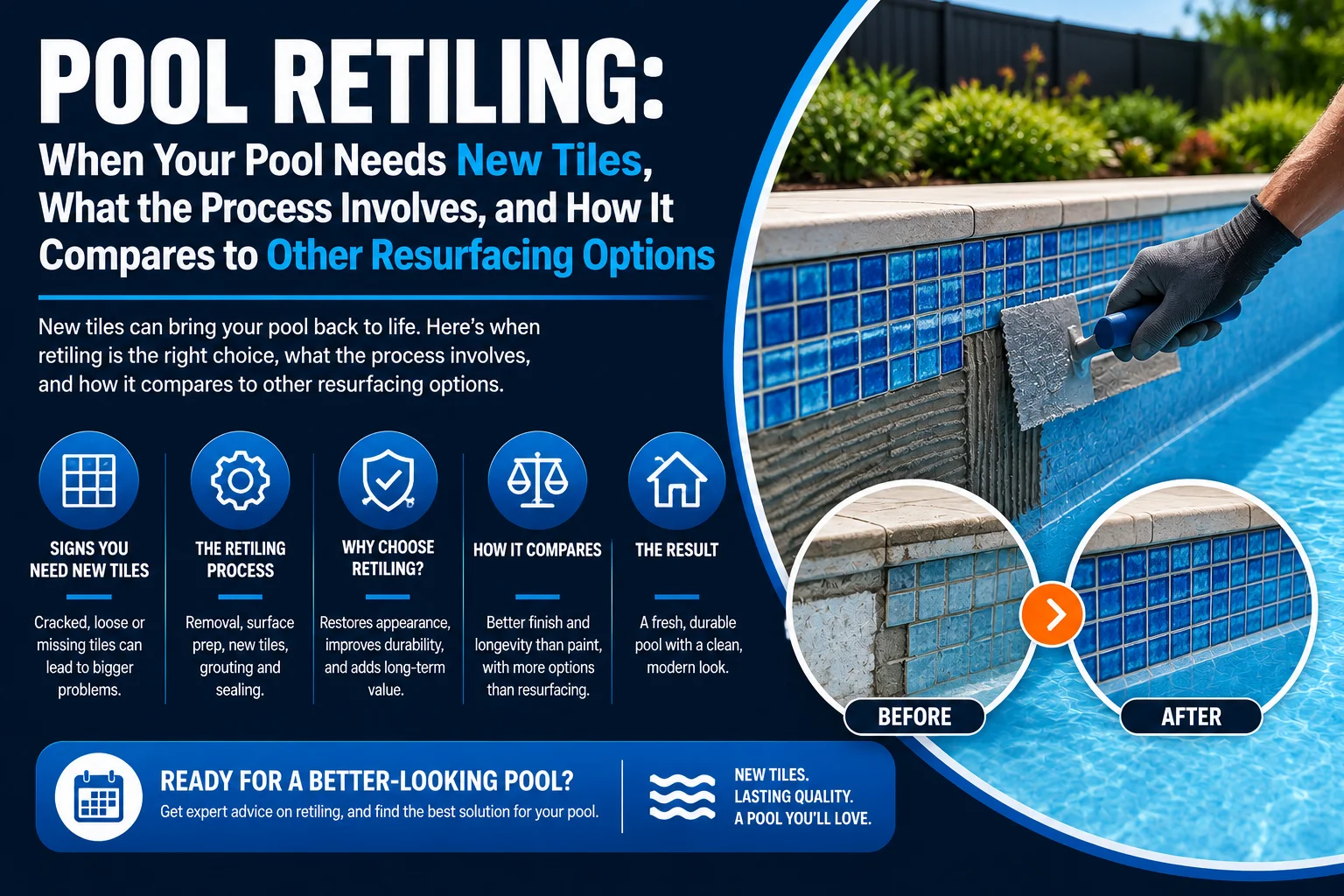
Pool retiling is a multi-stage project that typically takes one to three weeks depending on the pool size, tile type, and substrate condition.
Stage 1: Pool draining and assessment. The pool is drained completely. Once empty, the entire shell is inspected to assess the tile condition, substrate integrity, plumbing penetrations, and any structural issues (cracking, movement, delamination) that must be addressed before new tiles are installed. A pool inspection before quoting ensures the full scope is understood.
Stage 2: Tile removal. The existing tiles are removed from the pool shell using mechanical methods (angle grinder, chisel, or jackhammer depending on the tile type and adhesive). This is the most labour-intensive stage. All old adhesive residue is removed from the substrate to create a clean bonding surface for the new tiles.
Stage 3: Substrate preparation. The exposed substrate (concrete, render, or fibreglass) is inspected for cracks, delamination, and structural issues. Cracks are chased out and filled with flexible, waterproof repair compound. Delaminated render is removed and reapplied. The substrate must be structurally sound, level, and properly profiled before tiling begins because tiles bonded to a compromised substrate will fail prematurely. For pools with significant substrate damage, pool rendering may be needed to create a new base layer before tiling.
Stage 4: Waterproofing. A waterproof membrane is applied to the prepared substrate. This membrane is the primary barrier preventing pool water from penetrating the concrete shell and causing structural damage, water loss, and ground movement. The membrane must cure fully before tiling begins.
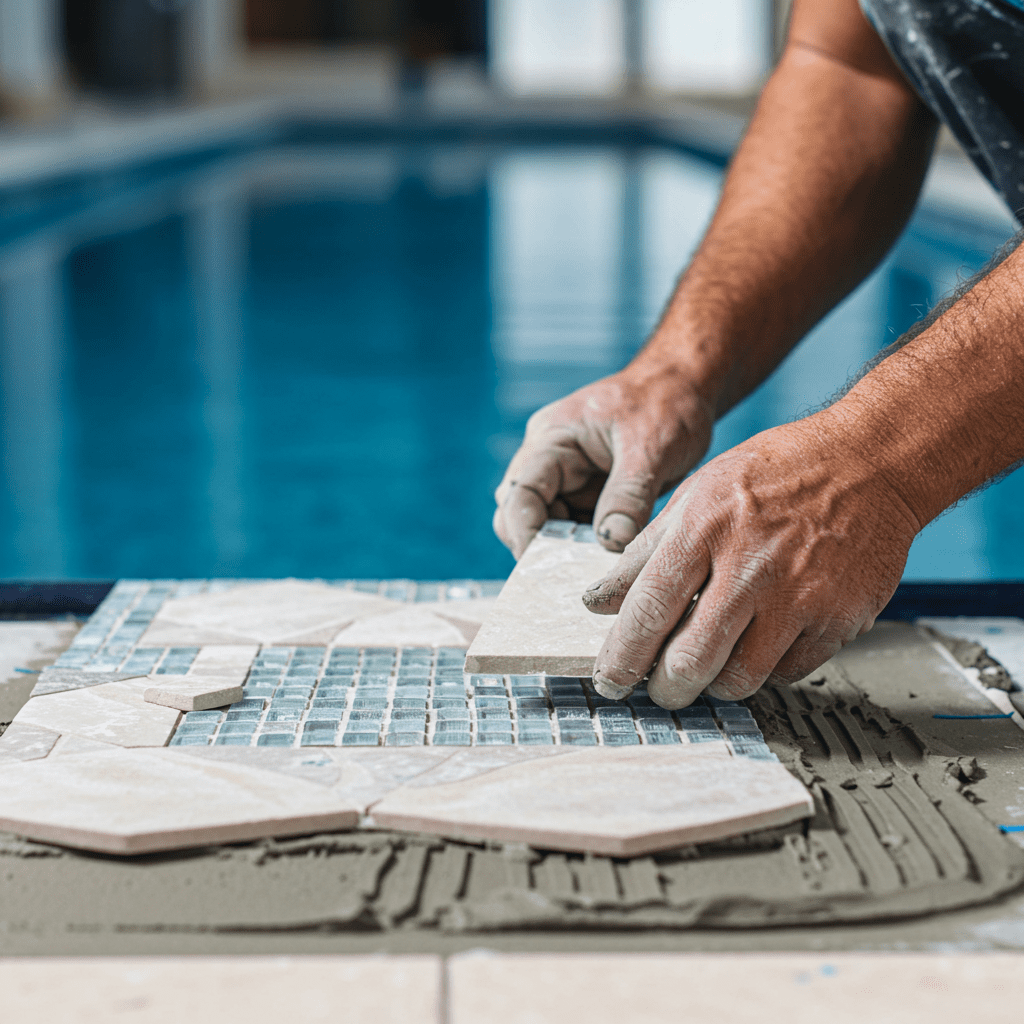
Stage 5: Tile installation. New tiles are set into waterproof, chemical-resistant adhesive formulated for permanent submersion. Tiles are laid systematically from the floor up, with consistent spacing maintained by tile spacers. Waterline tiles, step tiles, and feature tiles are positioned according to the agreed design. Each tile is back-buttered (adhesive applied to both the substrate and the tile back) for maximum bond strength in a submerged environment.
Stage 6: Grouting. Once the adhesive has cured (typically 24 to 48 hours), the joints between tiles are filled with epoxy or polymer-modified grout rated for pool use. Pool grout must be chemical-resistant (chlorine, salt, acid), waterproof, and flexible enough to accommodate minor thermal movement without cracking. Standard wall and floor grout is not suitable for pool environments.
Stage 7: Curing and filling. The grout cures for the period specified by the manufacturer (typically 7 to 14 days depending on the product). The pool is then filled, and the startup water chemistry process begins. For guidance on managing a newly surfaced pool, the pool resurfacing maintenance guide covers the critical first 28 days.
“The most common retiling failure we see is tiles installed over a substrate that was not properly prepared. The old adhesive was left on, the cracks were not repaired, or the waterproof membrane was skipped to save time. The tiles look perfect for six months, then they start detaching because the bond to the substrate was compromised from day one. Substrate preparation is where the longevity of a retile is determined.”
Pool Tile Material Options
The tile material affects the appearance, durability, maintenance requirements, slip resistance, and cost of the retile.
| Tile Material | Characteristics | Best For | Maintenance Level | Relative Cost |
|---|
| Ceramic mosaic | Most common pool tile. Available in a wide range of colours and patterns. Durable, chemical-resistant, relatively affordable. Standard 20x20mm or 25x25mm sheets. | Most residential pools. Versatile, cost-effective, wide design range. | Low to moderate. Resists staining well. Grout joints need periodic inspection. | $$ |
| Porcelain | Denser and less porous than ceramic. Superior chemical and stain resistance. Available in larger format tiles (up to 600x600mm) and mosaics. | Premium residential pools. Low-maintenance finish. Modern, clean aesthetic. | Low. Very resistant to staining, chemicals, and UV. | $$$ |
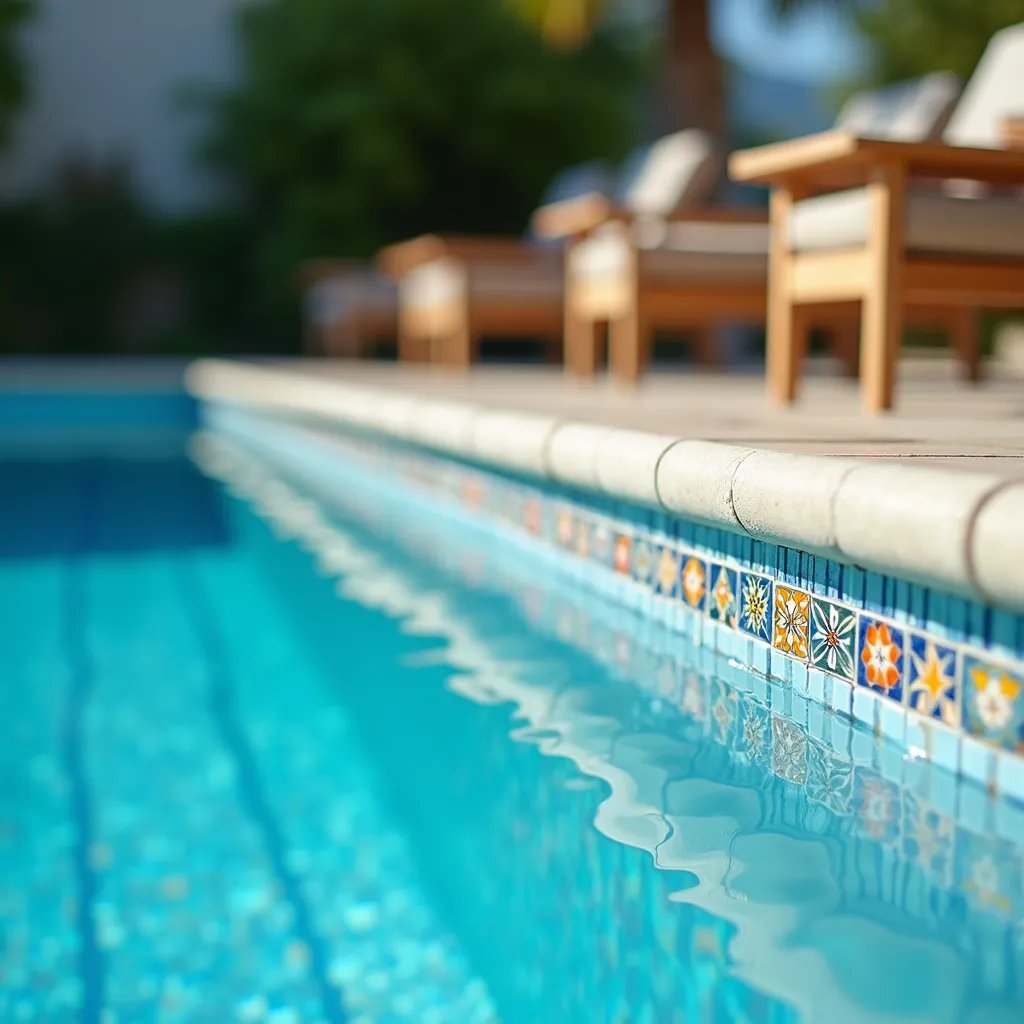
| Glass mosaic | Translucent, reflective surface that creates a luminous, shimmering water colour. Does not fade. Zero water absorption. Available in every colour. | Feature walls, waterline accents, luxury pools, pools where water colour and light effect are the priority. | Low. Non-porous surface resists staining and algae. | $$$$ |
| Natural stone (travertine, marble, granite) | Premium natural appearance. Each tile is unique. Requires sealing. Higher porosity than ceramic or porcelain. | Luxury pools with natural stone coping and surrounds. Coordinated pool and landscape design. | Higher. Requires periodic sealing. More susceptible to chemical etching and staining. | $$$$ |
| Fully vitrified tiles | Extremely low water absorption (less than 0.5%). Maximum freeze-thaw resistance. Industrial durability. | Commercial pools, high-traffic pools, pools in areas with ground movement. | Low. Extremely durable and chemical-resistant. | $$$ |
For a broader comparison of all pool surface types (tiles, pebblecrete, render, paint, fibreglass), the pool surface options guide covers every choice. For pricing context, the pool resurfacing cost guide covers all surface types.
What Affects Pool Retiling Cost
Several factors determine where your retiling project falls within the cost range.
Pool size and shape. Cost is driven primarily by the total surface area to be tiled, measured in square metres. A standard backyard pool (30 to 50 square metres of surface area) costs less than a large or irregularly shaped pool. Curved walls, steps, ledges, and spa sections add complexity and surface area.
Tile material. Ceramic mosaic is the most affordable. Porcelain costs more. Glass mosaic and natural stone are the premium options. The material cost per square metre varies significantly between these categories.
Substrate condition. A substrate in good condition (minor repairs only) adds minimal cost. A substrate with significant cracking, delamination, or structural issues that requires rendering, crack repair, or structural remediation before tiling adds to the project scope and cost.
Tile pattern and design. A single-colour tile laid in a standard grid pattern is the most straightforward installation. Feature bands, waterline accent tiles, mosaic murals, mixed materials, and complex patterns require more cutting, more time, and more skill.
Access and logistics. Pools with restricted access (narrow side passages, steep blocks, pools surrounded by fixed landscaping) add to the labour cost because materials must be carried in and waste carried out by hand.
Existing tile removal. Some existing tiles come off cleanly. Others (particularly tiles set in thick-bed mortar rather than thin-set adhesive) require more intensive removal. The removal difficulty affects the labour component of the project.
Pool Retiling vs Other Resurfacing Options
Retiling is the premium option but not always the necessary one. Understanding how it compares to other resurfacing methods helps you choose the right approach.
| Surface Option | Lifespan | Appearance | Maintenance | Best For |
|---|
| Tiling (ceramic or porcelain) | 15 to 25 years | Premium. Widest colour and design range. Does not fade. | Lowest long-term. Resists staining and chemicals. Grout needs periodic inspection. | Homeowners who want the longest-lasting, lowest-maintenance, most visually flexible finish. |
| Pebblecrete | 10 to 15 years | Natural aggregate texture. Range of stone colours and blends. | Moderate. Textured surface can trap algae. Needs periodic acid washing. | Homeowners who want a natural stone appearance with good durability. |
| Pool paint | 5 to 8 years (epoxy), 2 to 4 years (chlorinated rubber) | Clean, uniform colour. Limited colour range. Fades over time. | Higher. Requires repainting when the coating wears. | Budget-conscious resurfacing. Quick turnaround. |
| Render (with paint or pebble finish) | 10 to 15 years (as a substrate for another finish) | Depends on the topcoat applied. Smooth when painted, textured with pebble. | Moderate to higher. Render itself needs a protective topcoat (paint or pebble). | Pools with damaged substrates that need a new base layer before the final surface. |
Retiling has the highest upfront cost but the lowest lifetime cost because it lasts the longest and requires the least maintenance. Over a 25-year period, a retiled pool may cost less in total than a pool that is painted three to four times or pebblecreted twice.
Maintaining a Retiled Pool
A retiled pool is the lowest-maintenance pool surface option, but it is not zero-maintenance.
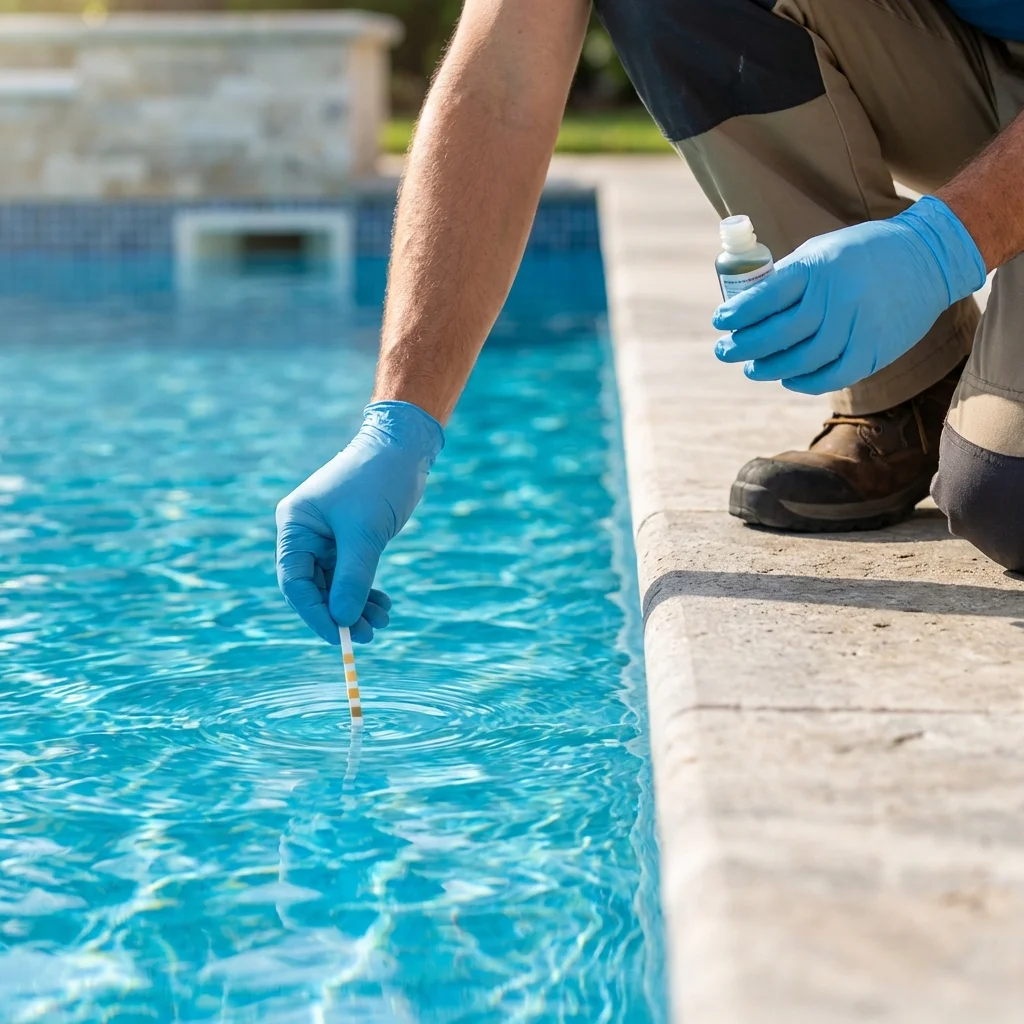
Water chemistry management. Maintain balanced water chemistry at all times: pH between 7.2 and 7.6, total alkalinity between 80 and 120 ppm, calcium hardness between 200 and 300 ppm. Aggressive water (low pH, low alkalinity) etches grout and can damage tile glazes over time. Scaling water (high pH, high calcium) deposits calcium on tile surfaces and in grout joints. Read the pool resurfacing maintenance guide for the full chemistry program.
Grout inspection. Check grout joints annually for cracking, discoloration, or deterioration. Damaged grout allows water behind the tiles, which can undermine adhesion and lead to tiles detaching. Spot regrouting small areas of failed grout prevents the problem from spreading.
Tile surface cleaning. Brush the tile surface weekly to prevent algae and calcium buildup, particularly along the waterline where mineral deposits accumulate fastest. For established stains, the how to remove pool stains guide covers treatment methods by stain type.
Waterline maintenance. The waterline (where the water surface meets the tile) is the highest-maintenance area. Oils, sunscreen, body fats, and mineral deposits accumulate at the waterline and discolour the tiles and grout. Regular cleaning with a tile-specific cleaner prevents buildup from becoming embedded.
Avoid abrasive cleaning tools. Stainless steel brushes, scouring pads, and abrasive cleaners scratch tile glazes and damage grout. Use nylon brushes and non-abrasive, pool-specific cleaning products.