Who Needs a Pool Safety Inspection in NSW?
Every property in NSW with a swimming pool or spa that is capable of being filled with water to a depth of 300mm or more is subject to the swimming pool safety requirements.
This includes in-ground pools, above-ground pools, portable pools that remain erected for more than 30 days, spa pools, and plunge pools. Even if your pool has been drained and is not currently in use, it is still subject to the legislation if it is capable of being refilled.
When a compliance certificate is required:
Selling a property with a pool requires a valid compliance certificate (or a relevant occupation certificate for pools built after 2016) before the contract of sale is exchanged. Without it, the sale cannot legally proceed.
Leasing a property with a pool requires the landlord to have a valid compliance certificate that is renewed every three years for the duration of the tenancy.
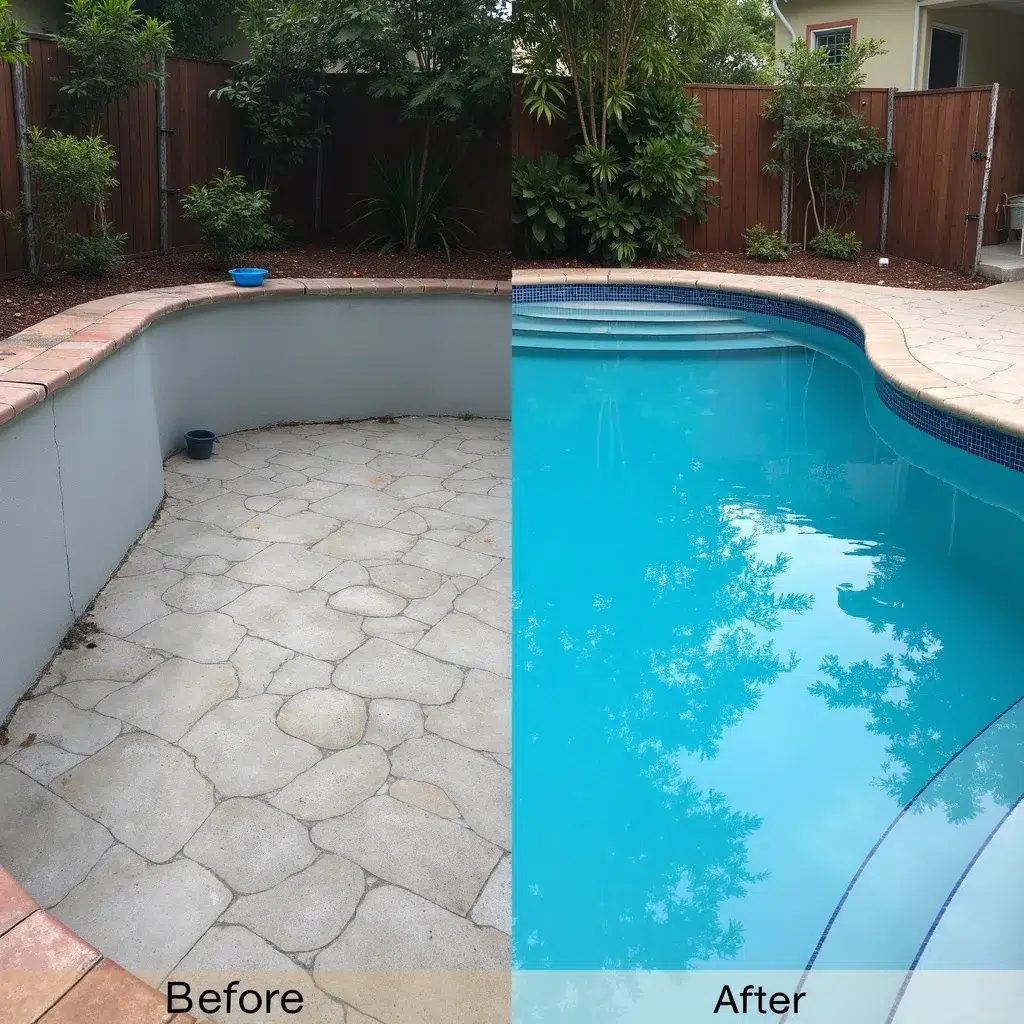
After a pool renovation, depending on the scope of work, a new compliance check may be needed, particularly if the barrier, fencing, or pool surrounds were altered during the project. If your renovation with Advance Pool Painting involves changes to pool surrounds, paving, or coping near the barrier line, the compliance implications should be discussed before work begins.
What Does a Pool Safety Inspector Actually Check?
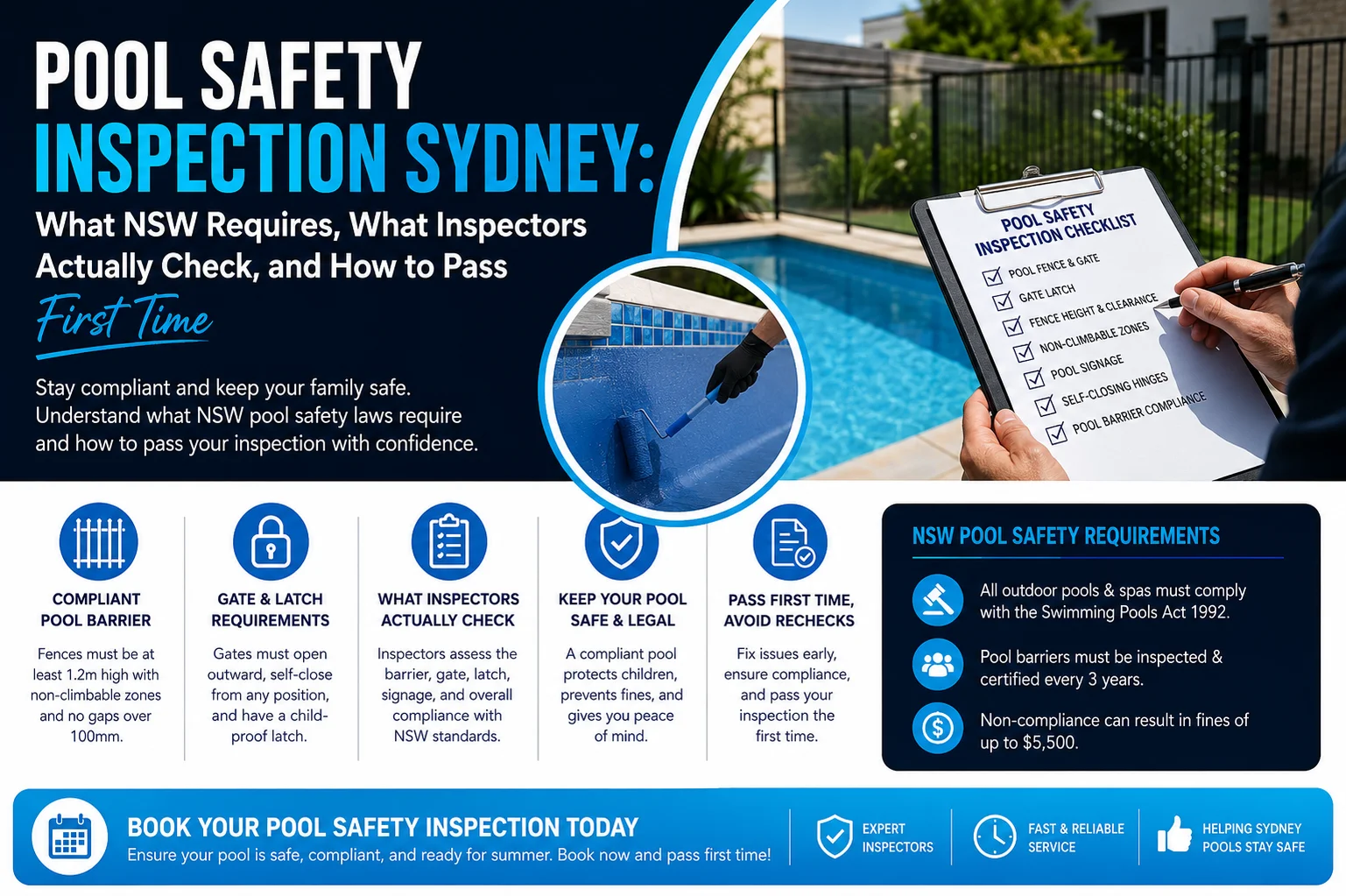
The inspection follows the requirements of the Swimming Pools Act 1992 and the Swimming Pools Regulation 2018. Here is what every inspector assesses.
| Inspection Area | What Is Checked | Common Failure Points |
|---|---|---|
| Pool barrier (fence) | Height (minimum 1200mm), no climbable footholds, gaps under fence within limits, structural integrity | Fence height reduced by raised garden beds or retaining walls on the outside, palings with horizontal rails that create footholds |
| Gate and latch | Self-closing from any position, self-latching, latch at correct height (minimum 1500mm from ground or shielded), opens outward away from the pool | Gate hinges worn and not self-closing, latch mechanism corroded or misaligned, gate propped open by objects |
| Climbable zone | No objects within 900mm of the barrier that could be used to climb over (on the non-pool side) | Outdoor furniture, pot plants, air conditioning units, wheelie bins, garden sheds, retaining walls, trees with low branches |
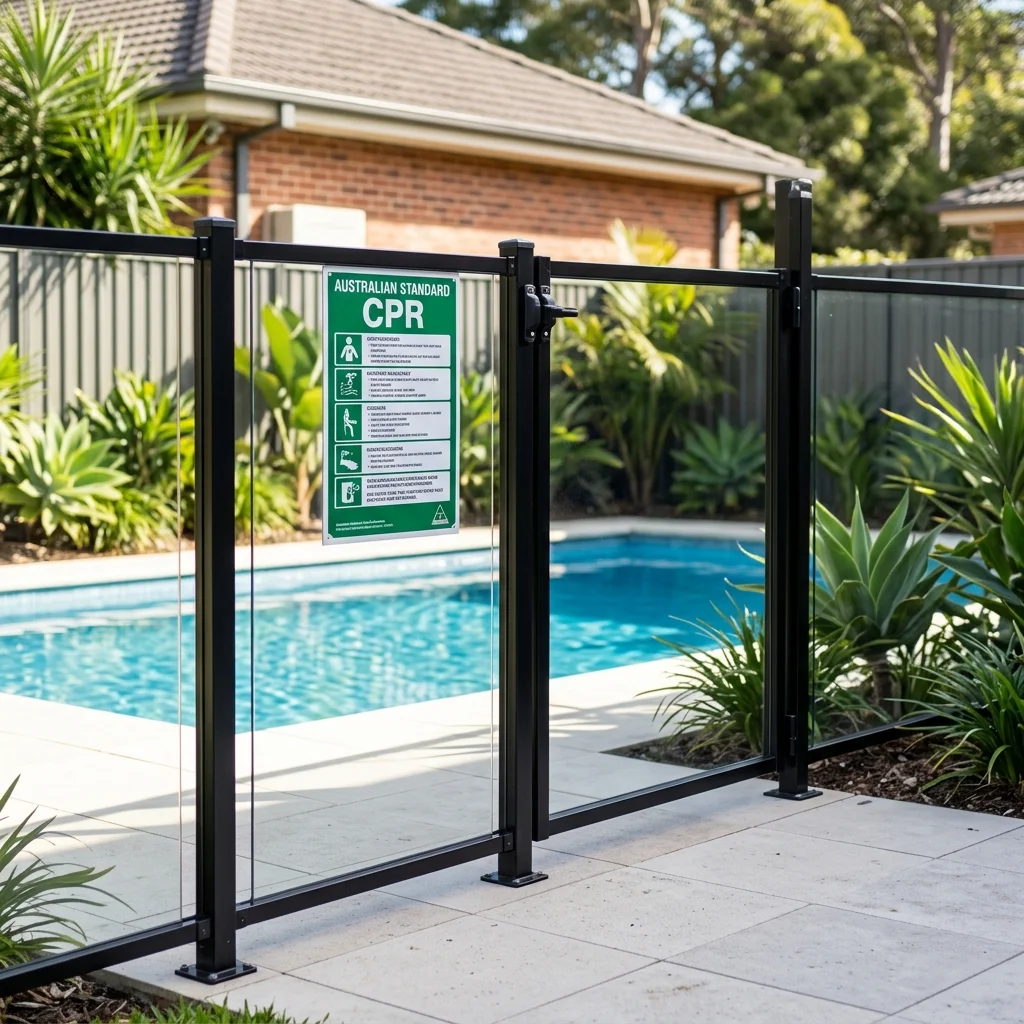
| CPR signage | Current CPR resuscitation chart displayed in a prominent position within the pool area | Missing entirely, outdated chart (guidelines update periodically), chart faded and unreadable |
| Window and door barriers | Any window or door providing direct access to the pool area must have compliant barriers or be non-openable beyond 125mm | Sliding doors without self-closing mechanisms, windows that open wider than 125mm without a restrictor |
| Pool area condition | General safety of the pool area including slip hazards, broken surfaces, and access points | Cracked pool surrounds creating trip hazards, broken coping stones with sharp edges |
“The most common failure we see is the climbable zone issue. Homeowners do not realise that a pot plant, a chair, or even a garden bed retaining wall within 900mm of the outside of the fence gives a child a stepping platform to climb over. Moving these items often fixes the issue instantly.”
Most Common Reasons Sydney Pools Fail Inspection
Understanding why pools fail helps you fix problems before the inspector arrives rather than paying for a re-inspection.
Gates not self-closing and self-latching. This is the number one failure across Sydney. Pool gates must close and latch automatically from any open position, including being fully open. Worn hinges, corroded latches, and gates that have dropped on their hinges are the most frequent causes. A gate that requires manual effort to close or latch does not pass.
Climbable objects in the exclusion zone. Any object within 900mm of the non-pool side of the fence that a child could use as a climbing aid fails the inspection. This includes items homeowners never think about: outdoor air conditioning units, hot water systems, retaining walls, garden beds with raised edging, compost bins, pool filter housings mounted near the fence, and even thick horizontal fence rails.
Fence height non-compliant. The barrier must be at least 1200mm high, measured from the finished ground level on the non-pool side. If the ground level outside the fence has been raised (by a new garden bed, paving, or soil accumulation over years), the effective fence height may be less than 1200mm even though the fence itself has not changed.
Gaps exceeding limits. The gap between the bottom of the fence and the ground must not exceed 100mm. Gaps between fence palings or panels must not exceed 100mm. Ground erosion, fence settlement, and shifting palings can create gaps that exceed these limits over time.
Missing or outdated CPR signage. A current CPR resuscitation chart must be displayed prominently within the pool area. Charts must be legible and current. The Royal Life Saving Society updates CPR guidelines periodically, so older charts may no longer meet requirements.
How to Prepare for a Pool Safety Inspection
Before booking an inspector, walk through these checks yourself to identify and fix obvious issues.
Test every gate. Open it fully, let go, and watch whether it closes and latches completely on its own. Do this multiple times from different open positions. If the gate sticks, drags on the ground, or the latch does not engage every time, fix the hinges and latch before the inspection.
Clear the climbable zone. Walk around the outside of the entire pool fence and remove or relocate anything within 900mm that could be used as a step. Check for less obvious items like garden hose reels mounted on fence posts, decorative objects, and firewood stacks.
Measure the fence height. Use a tape measure from the current ground level on the outside of the fence to the top. Check at multiple points around the perimeter because ground levels can vary. Every point must be at least 1200mm.
Check for gaps. Inspect the bottom of the fence all the way around for gaps exceeding 100mm. Check between every paling or panel for gaps exceeding 100mm. Years of ground movement and weathering create gaps that were not there when the fence was installed.
Check your CPR chart. Make sure it is current (check the date on the chart), clearly visible, not faded, and displayed in a prominent location within the pool area.
Inspect windows and doors. Any door or window that opens directly to the pool area must have a self-closing mechanism or be restricted to a maximum opening of 125mm. Sliding doors are the most common failure point.
For an initial assessment of your pool’s overall condition including the pool shell, surface, and equipment alongside safety compliance, a professional pool inspection covers everything in one visit. The pool inspection cost guide covers what to expect for pricing.
Pool Renovations and Safety Compliance
If you are planning a pool renovation, the safety compliance angle is worth considering early in the planning process.
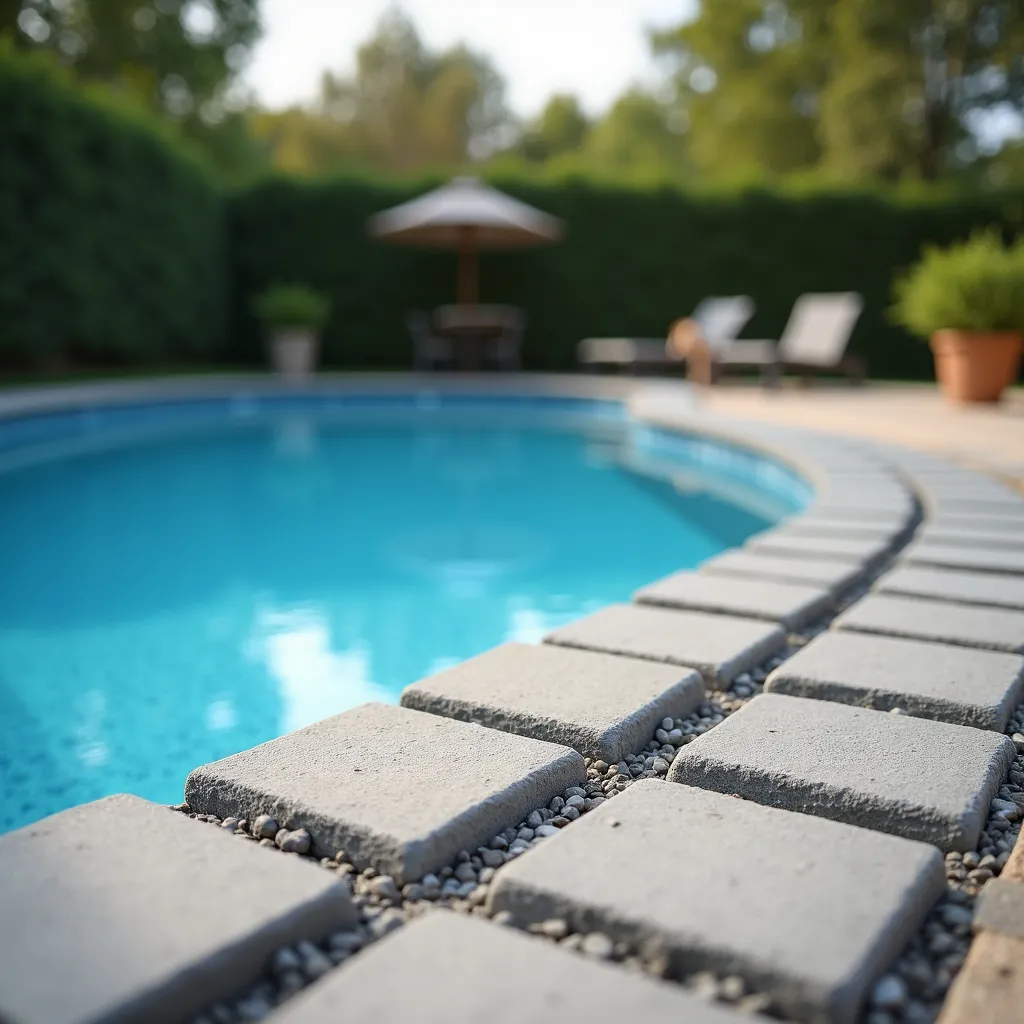
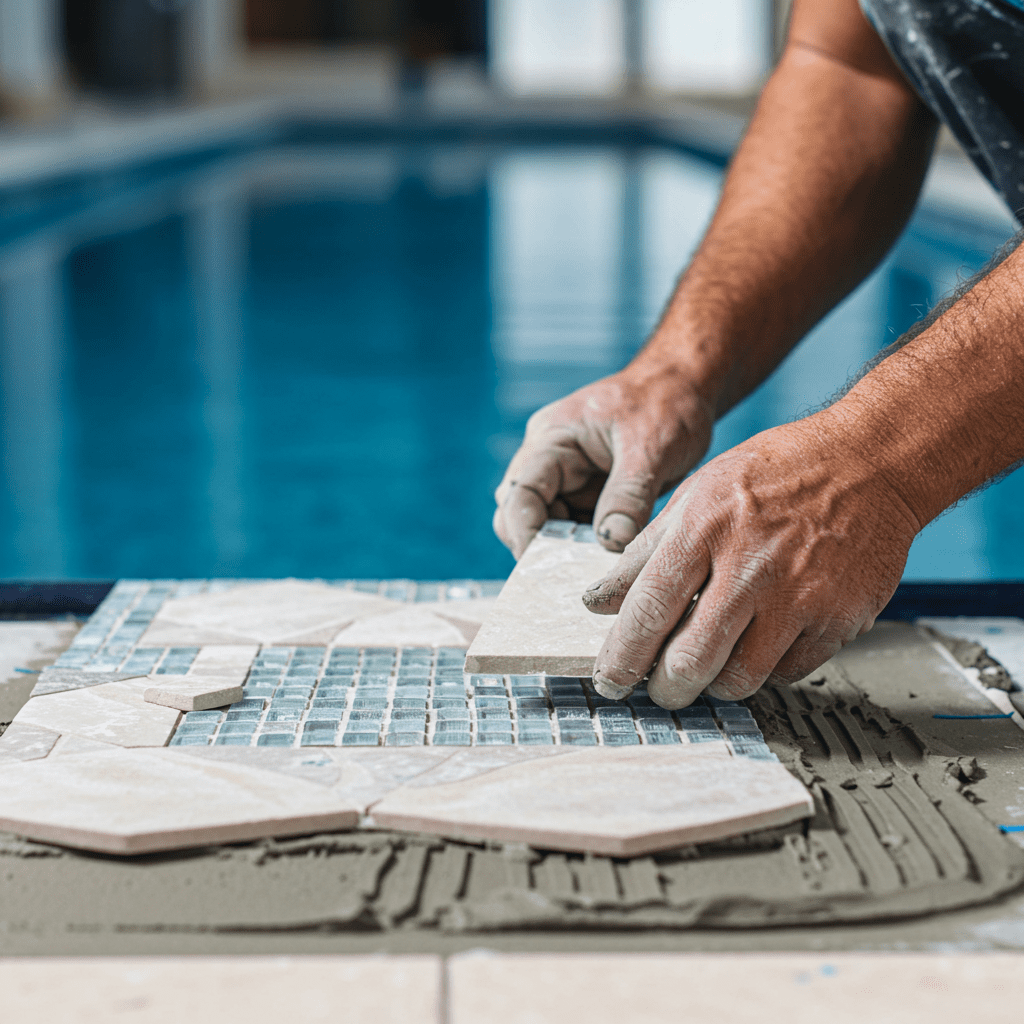
Renovation work that alters the pool barrier line, changes ground levels around the fence, modifies access points to the pool area, or replaces pool surrounds and paving near the fence can affect compliance status. New coping that raises the ground level on the pool side, or new paving that changes drainage patterns near the fence, should be designed with compliance in mind.
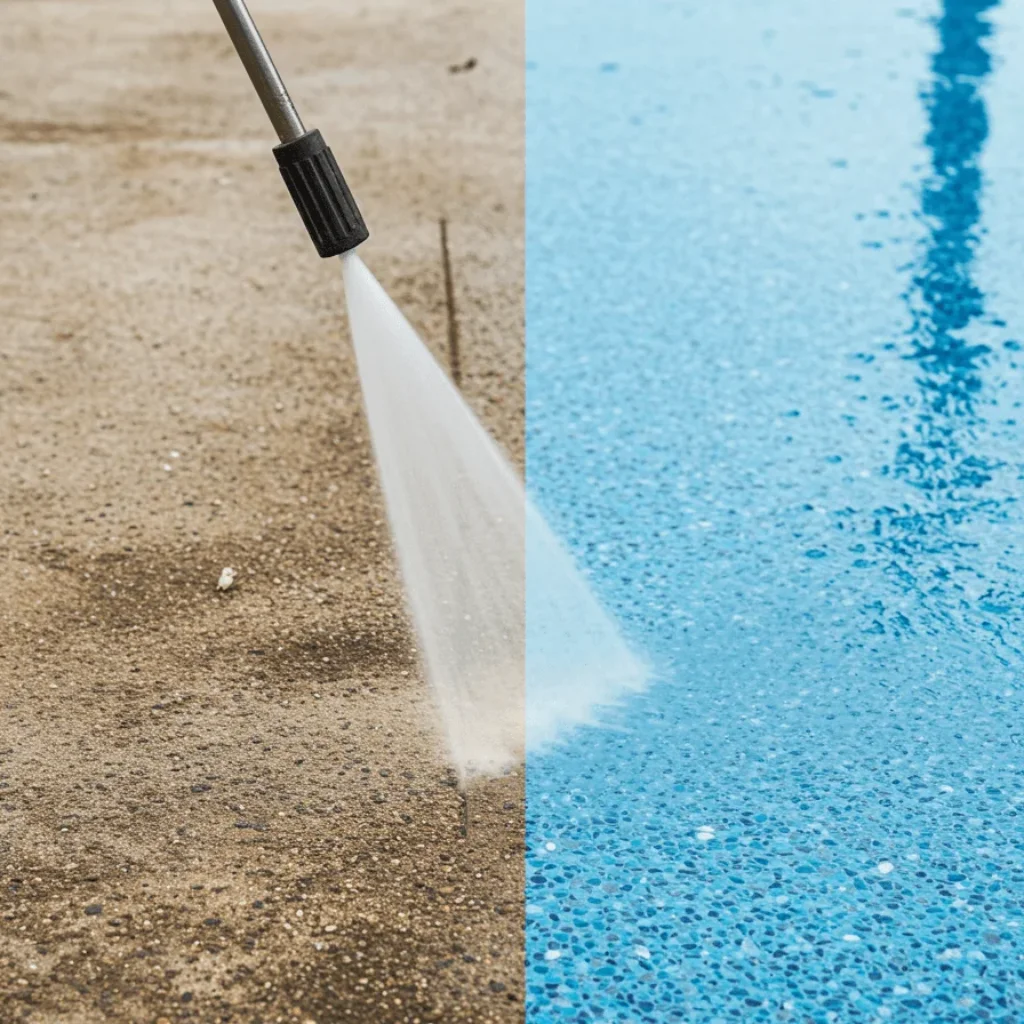
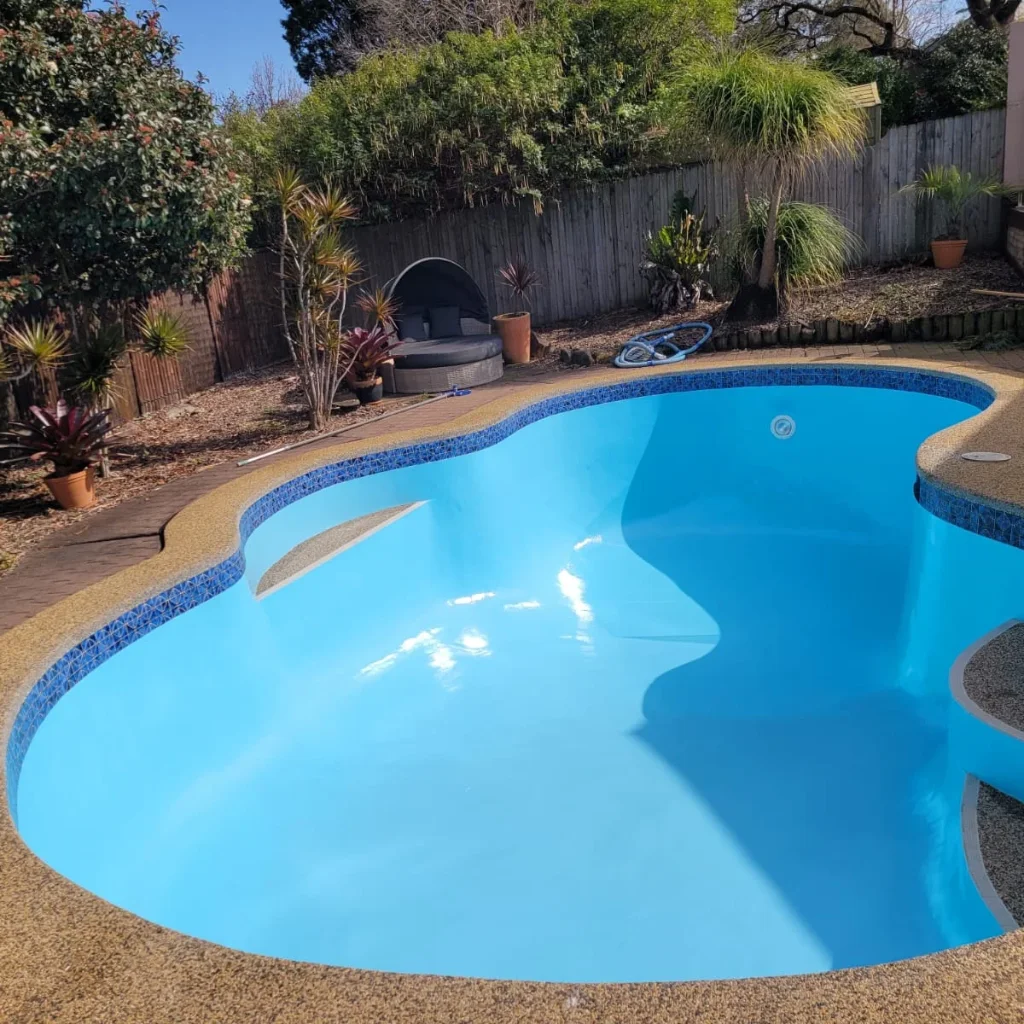
Similarly, if your pool is being resurfaced with pebblecrete, painted, or tiled, the renovation period is the ideal time to address any existing compliance issues. The pool is already out of commission, contractors are already on site, and fixing barrier issues during the renovation avoids a separate mobilisation and cost later.
Contact Advance Pool Painting to discuss how your renovation scope interacts with safety compliance requirements.